How MaxLevels Built RouteMe's App-Free Indoor Navigation and Wayfinding Platform
MaxLevels partnered with RouteMe, an Orlando-based indoor navigation company, to engineer a wayfinding platform that needs no app, no login, and no beacons — just a scanned QR code and a real-time route.
- Built an app-free navigation platform, QR/NFC/App Clip/Instant App access, with no beacons, Wi-Fi triangulation, or dedicated hardware required

- Accessibility built in from the architecture up: haptic feedback, voice-ready turn-by-turn, WCAG AAA high-contrast mode, and step-free accessible-only routing
- Deployed across airports, an airline, a hospital, and a rental car network, each a different navigation problem solved on the same platform
- 94.3% passenger satisfaction, 12,000+ routes completed weekly, 22 languages supported automatically
At a Glance

Why This Had to Be Built
Wayfinding should just work.
Large airports and other complex environments create confusion for first-time travelers, international passengers, people with mobility challenges, and anyone dealing with changing destinations.
Static signs cannot adapt in real time. Beacon-based navigation adds hardware and maintenance. Dedicated apps add download friction.
RouteMe needed a scalable platform that could work across airports and very different venue types without requiring new physical infrastructure.

Complex, multi-terminal environments
Hardware-dependent positioning
Accessibility and language gaps
App-download friction
Scalability
Static signage
How RouteMe Gets Someone From Curb to Gate
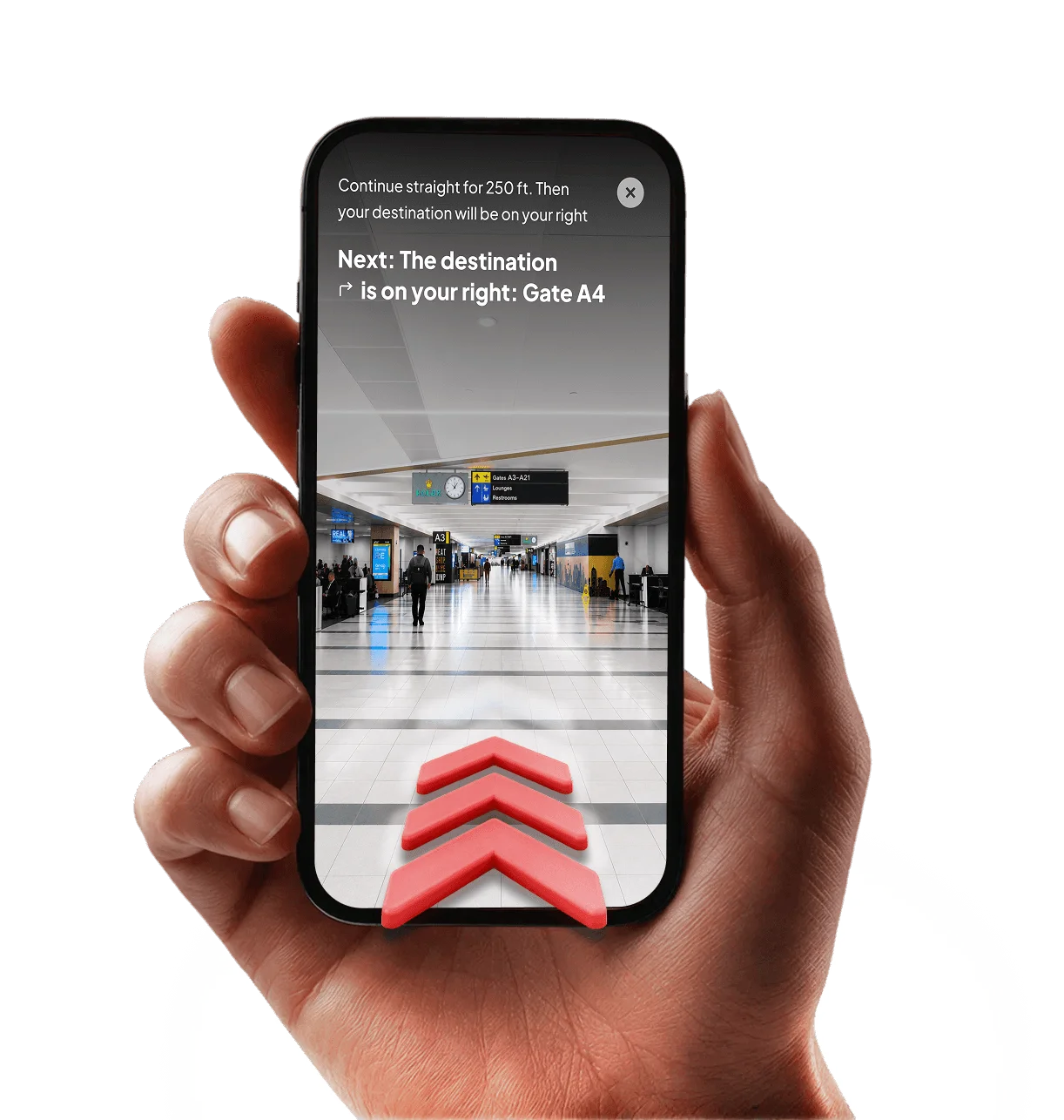
MaxLevels engineered an enterprise-grade, app-free navigation platform using AI-based localization and computer vision instead of beacons or Wi-Fi triangulation.
A QR code, NFC tap, shared link, App Clip or Instant App launches the experience immediately. The route is generated around the user's destination and adapts as they move.
Engineering Decisions Worth Knowing About

Computer vision instead of beacons
Hardware positioning means installing and maintaining beacons in every venue — a real cost each time RouteMe adds a location. Building localization on computer vision and AI means a new terminal or hospital wing can go live without an electrician.

Accuracy as an engineering target
he platform holds accuracy within roughly half a meter on routes over 300 meters long, tight enough that augmented-reality-guided routes stay trustworthy over real airport distances, not just in a demo.

Node.js for real-time, Python for the harder computation
Recalculating a route as someone moves needs near-zero lag — a Node.js strength. The localization and vision work underneath is a different problem, better suited to Python's ecosystem.

Flutter and Kotlin, not one layer for everything
Instant, no-install access (Android Instant Apps, Apple App Clips) has to feel native the moment it launches. Flutter for shared logic, native Kotlin where Android performance mattered, kept “scan and go” fast on both ecosystems.
Built for Every Traveler, Not Just the Average One
Accessibility wasn’t an add-on feature, it shaped the architecture. Routes can be generated as accessible-only, avoiding stairs and prioritizing ramps and elevators automatically. Every direction is voice-ready, tested against VoiceOver and TalkBack so a blind or low-vision traveler gets the same guidance as anyone else.
Haptic feedback delivers turn cues without requiring anyone to look at a screen, and a WCAG AAA high-contrast mode serves users with low vision. None of this required a separate accessible version of the app, because there’s no app to fork in the first place.
The Results

Beacon-based wayfinding vs. RouteMe
A head-to-head read: each row names the dimension, then both sides answer it on equal footing.
 Bluetooth beacons or Wi-Fi
triangulation required in every location
Usually requires an app download
Often bolted on separately
 None; runs on existing infrastructure
Scan a QR code or tap a link, no install
Voice, haptic, and step-free routing
None; runs on existing infrastructure
Scan a QR code or tap a link, no install
Voice, haptic, and step-free routingbuilt into the core platform
Proven Across Real Deployments
RouteMe isn't running in one pilot location. It guides passengers through Miami International Airport's terminals and rental car facilities, is installed at Athens International Airport, powers wayfinding inside the Avianca app for Latin American and Caribbean travelers, helps patients and families find their way at Tampa General Hospital, and guides renters to their vehicles at Sixt locations.
Four very different environments — airport, airline, hospital, rental counter — running on the same underlying platform.



What's Next for RouteMe's Platform

RouteMe Agent
A conversational layer that answers the questions passengers actually ask beyond directions, wait times, food recommendations, where a rental car is parked.

Pre-Arrival Navigation
Turn-by-turn directions sent before someone even steps inside, already integrating with MyChart/EHR for healthcare visits and Outlook for calendar-linked arrivals.

RouteMe Pro
A live operator dashboard for editing routes, toggling them on and off, and adjusting wayfinding without a new deployment cycle.

Kids Mode
A navigation experience built for younger visitors, larger text, friendlier voice prompts, and simplified routing.
Frequently Asked Questions
An enterprise-grade, app-free indoor navigation platform using AI-based localization and computer vision instead of beacons, with accessibility (voice, haptic, high-contrast, step-free routing) built into the core architecture, deployed across airports, an airline, a hospital, and rental car locations.
94.3% passenger satisfaction, 12,000+ routes completed weekly, and automatic support for 22 languages across live deployments including Miami International Airport and Athens International Airport.
No. RouteMe runs entirely in the mobile browser after a QR scan, NFC tap, or shared link, and requires no Bluetooth beacons, Wi-Fi triangulation hardware, or other physical infrastructure.
Yes. The platform includes accessible-only routing that avoids stairs, VoiceOver and TalkBack-tested voice guidance, haptic turn cues, and a WCAG AAA-compliant high-contrast mode, all built into the core platform rather than offered as a separate version.
Live deployments include Miami International Airport, Athens International Airport, Avianca flights, Tampa General Hospital, and Sixt rental car locations.
Ready to build enterprise software your users will actually use?
Schedule a Free Strategy Call